At the beginning of this year, I had set my mind to do what I have always done. My goals were clear, and I was prepared to tackle them with the resources, discipline, grit, and love for my work that I have always lived by. But then a shift came unexpectedly, and inwardly I knew I was being challenged. I looked right, left, and center for clarity, but it was not there. So, I looked up to God, stayed the course, and took one step at a time.
Then I heard Oprah interviewing Jim Collins about his newest book, What to Make of a Life (see the interview here: https://www.youtube.com/watch?v=oQ87NBMh538). I immediately ordered a copy. As I began reading about “cliffs, fog, fire, and the self-knowledge imperative, encodings,” something connected. Collins writes about people who encountered the cliffs of life, had to pivot, and sometimes had to dig deeper within themselves to discover another level of who they were and what they could become. I will not spoil the book for you; please get yourself a copy. 😊
This month, as I turn another year older in my fifties, I find myself grateful not only for another year of life, but also for some of the cliffs and the reinforcement of the “encodings.” I will admit that there are a few cliffs I would have happily walked around if given the choice! But looking back, some of those cliffs forced me to see differently, think differently, and move differently. And that got me thinking about business, customers, and some of the shifts I have had the privilege of watching over the past few years.
Two Years of Learning Through the Lens of the Customer
This month also marks the second anniversary of the Customer Centricity Circle, and that gives me another reason to celebrate.
For 24 consecutive months, we have gathered on the third Friday of every month to talk about all things business through the lens of the customer. Our guest speakers have challenged us to think about resilient leadership and the mindset required to remain customer focused; Lean Thinking and how eliminating waste can create greater customer value; change management through a customer-centric lens; designing the experience economy through biophilic design, atmospherics, and sensory marketing; AI and its growing influence on the customer experience; and so much more. Sometimes five people show up; sometimes twenty or more. We meet anyway. 😊
Today, our community has grown to more than 100 people, and I am deeply grateful to every guest speaker who has generously shared their expertise and every community member who has joined us, whether regularly or whenever life and work permit. What matters to me is not simply how many people are in the room. It is what happens after we leave it. If a leader thinks differently, changes a process, asks a better question, removes friction, or makes one decision differently because they considered the customer, then the learning has traveled beyond the Circle. And that, for me, is what these two years have really been about.
Sometimes the Shift Is Toward the Customer
One of the businesses whose journey I have had the opportunity to observe is Unexpected Atlanta. A member of their team has been part of the Customer Centricity Circle from the beginning and previously completed the Customer Centricity Certification program we delivered at USF.
What I appreciate about their journey is that they did not treat customer centricity as another way of saying, “Let’s provide great service.” They intentionally began shifting from product centricity toward customer centricity and examining how their services and business capabilities could be designed around creating multidimensional value for both the customer and the organization. That distinction matters.
It is relatively easy to tell employees to “put the customer first.” It is much harder to examine your business architecture, processes, decisions, offerings, and ways of working and ask whether they enable people to do it.
On September 18, 2026, as part of our anniversary Customer Centricity Circle, we heard more about that journey directly from Dr. Margaret Spencer of Unexpected Atlanta: not only what has worked, but also what they have learned along the way. Because real transformation rarely travels in a perfectly straight line.
Sometimes Customer Centricity Means Helping a Customer Leave
There is another story I want to share because it challenged me to think about customer centricity from a different perspective.
For approximately seven years, Snellville Websites Today (https://snellvillewebsitestoday.com/) supported Almenta International’s website. Now, I appreciate a beautiful, functional, and efficient website, but website languages, hosting configurations, domains, and all the technical things happening behind the screen are not where my expertise lives. I know my lane. 😊
Over the years, they did much more than maintain a website. They educated me, advised me, helped me understand decisions I needed to make, communicated consistently, and often went beyond what I expected.
This year, Almenta reached a point where our website needs changed, and it became clear that I needed capabilities beyond what their current business structure could provide. I wish I could tell you that was an easy conversation. It wasn’t. Seven years is a long relationship.
But what happened next is what stayed with me. Instead of making it difficult for me to leave, they helped me leave well. They offered to speak directly with the new website developer and hosting provider, provided information needed for the transition, advised on the domain and other technical considerations, and helped make sure that Almenta could move forward successfully even though moving forward meant moving away from them. Think about that for a moment. They helped their customer leave.
There was no immediate revenue benefit in doing that. There was simply an understanding that the customer’s needs had changed and that doing what was right for the customer mattered more than holding onto the account. That, to me, is the heart of customer centricity.
We often talk about putting the customer first when doing so also benefits the business. But what happens when the customer’s next best decision does not include us? Are we secure enough in the value we provide to say, “We may no longer be the right fit for what you need next, but we are going to help you get there successfully”?
Perhaps one of the greatest measures of customer centricity is not only how we welcome customers, serve them, and retain them, but also how we treat them when their journey takes them somewhere else.
The Shift May Be Trying to Tell You Something
As I celebrate another birthday and two years of the Customer Centricity Circle, I keep coming back to the cliffs and shifts Jim Collins writes about.
A shift does not always mean something is wrong. Sometimes your customer has changed. Sometimes your market has changed. Sometimes your organization has outgrown a process, relationship, product, or way of working that served you beautifully for years. And sometimes you have changed.
The difficult part is recognizing when staying exactly where you are has become riskier than moving forward.
Your Action Plan
This month, I invite you to pause and look at your own business through that lens:
- Look for the shift. What has changed or is changing around your customers, your market, your people, or your business?
- Listen to the customer. Are your customers asking for something different from what they needed from you two or three years ago?
- Examine what has served its purpose. What worked beautifully in one season but may no longer be sufficient for the next?
- Look beyond retention. Are you holding onto a customer, product, process, or relationship because it is genuinely creating value or simply because letting go is uncomfortable?
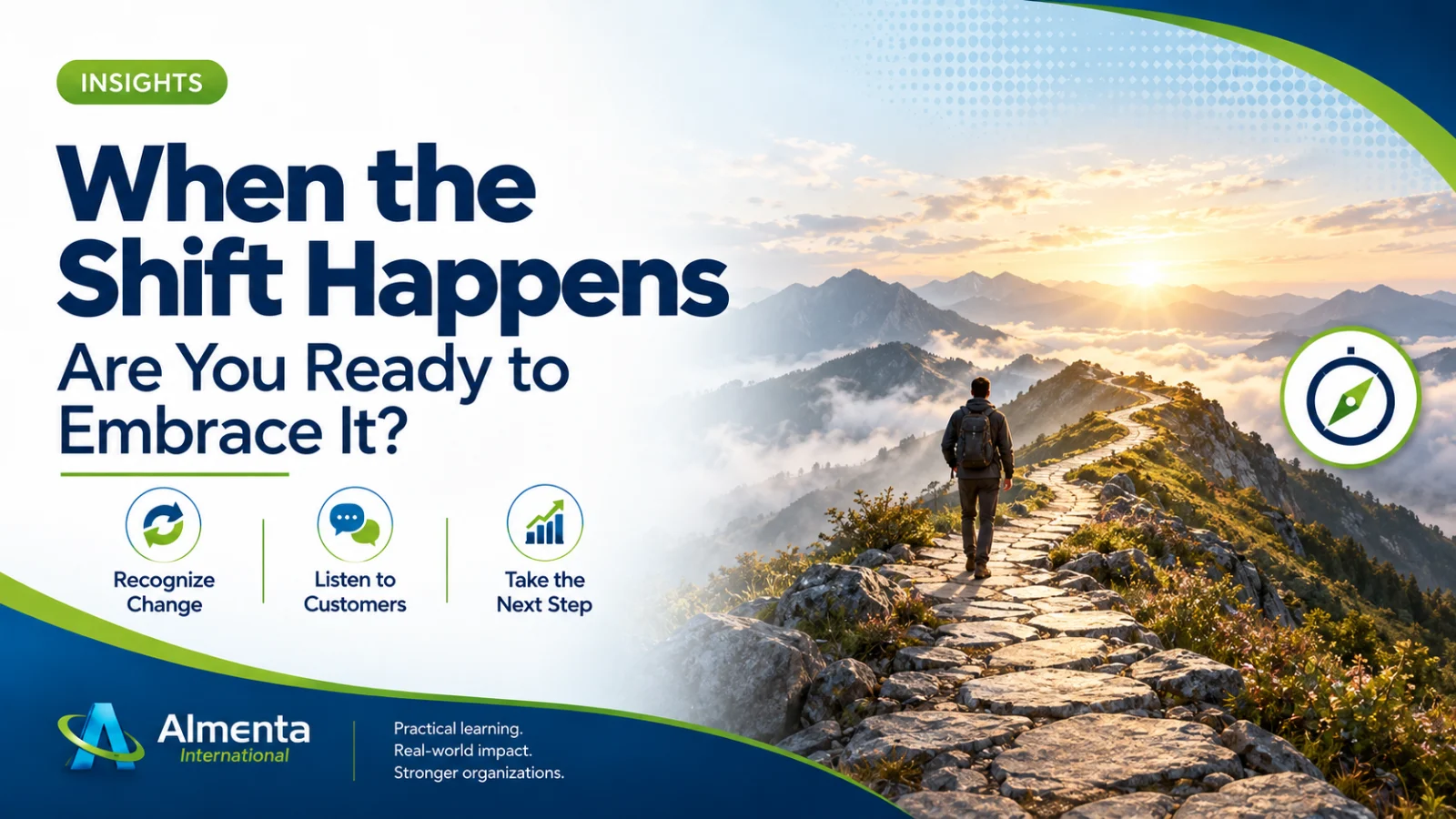
- Take one step. You may not be able to see beyond the fog yet, but what is one thoughtful move you can make in the direction you believe you need to go?
I am learning that we do not always get a clear view of the entire road before we are asked to move. Sometimes we get enough clarity for just the next step. And perhaps that is enough. When the shift happens, are you ready to embrace it?
For more information, contact info@almentainternational.net or visit www.almentainternational.com.